The GPO Tuned Percussion
By Terry Dwyer
Introduction
This is not going to be a lot of detailed advice so much as a summary of possibilities, to help users pinpoint the limitations of each instrument quickly, and write appropriately for it.
The instruments concerned in GPO are:
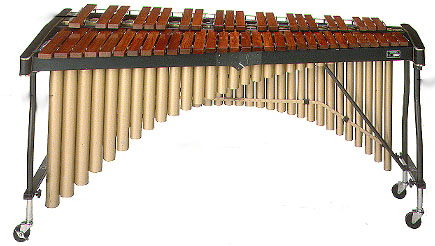
Wood instruments : Xylophone, Marimba, Grand Concert Marimba.
Metal instruments: Glockenspiel, Celesta, Vibraphone, Tubular Bells, Crotales.
String instrument : Piano. (yes, it’s a percussion instrument, isn’t it? Use the Lite version.)
Probably the most useful thing I can do immediately is to give you a table of instrument ranges, for quick reference:
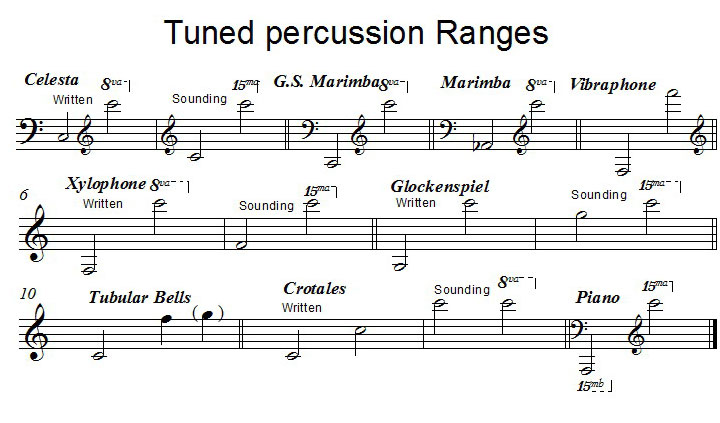
N.B. The sounding range of each GPO instrument is what appears when it is loaded into the Kontakt player, so if you want to input from your keyboard using the normal notated range, you must compensate by octave or double-octave transpositions within your sequencer. For some reason the GPO Crotales are an exception to this: you may play at the written range and the transposition has already been done for you.
The top G of the tubular bells is in brackets because although the GPO instrument possesses it, also the F#, most actual sets stop at F.
But there are other things you need to know, so here’s another table, showing useful facts about each instrument. Explanation below.
|
Instrument |
Played by |
Sustain? |
Dynamics |
Chords/Sing |
Soloist? |
Function |
Celesta |
Keyboard |
Yes |
p-f |
C |
Y |
DHA |
G S Marimba |
Sticks |
No |
pp-mf |
C |
Y |
D(H)A |
Marimba |
Sticks |
No |
pp-mf |
C |
Y |
D(H)A |
Xylophone |
Sticks |
No |
pp-f |
S/C |
Y |
DA |
Vibraphone |
Sticks |
Yes |
pp-f |
S/C |
Y |
HA |
Glockenspiel |
Sticks |
Yes |
p-f |
S* |
N/N |
D(A) |
Tubular Bells |
Hammer |
Yes |
p-ff |
S |
N/N |
D(A) |
Crotales |
Beater |
Yes |
pp-mf |
S |
N/N |
A |
Piano |
Keyboard |
Optional |
pp-ff |
C |
Y |
DHA |
Sustain? means : Do we normally expect a long sound, dying away naturally?
Dynamics means the normal range of loudness. These are given approximately, avoiding ppp & fff.
Chords/Sing means: do we expect to play chords, or just single notes? (*The glockenspiel can play double notes, but is apt to produce harsh difference tones, so confine double notes to the octave.)
Soloist? means: Is this instrument normally good as a soloist? (I suppose anything could be a soloist, but I’m giving safe advice.) So N/N stands for "Not normally".
Function shows which of three orchestral functions each instrument is suited for. "D" is "suitable for doubling other instruments to "put icing on the cake"; "H" is "suitable to provide harmony, whether as chords or arpeggios/figurations"; "A" means "use alone if need be".
Further Notes
- Sticks All the stick instruments except glockenspiel can be played with two sticks in each hand, making 4-part chords possible. However, only the more skilled players should be trusted to cope with this. Most amateurs will only manage one stick in each hand.
- Audibility Piano, xylophone, glockenspiel and tubular bells can be trusted to be heard over an orchestral tutti, marimbas and crotales need a fairly quiet environment to be heard well. Celesta and vibes can manage in anything up to a loudish mf, but if in doubt, make room for them.
- Availability Unless you are writing for a top professional orchestra, it is wise not to write for instruments which may not be available (probably for reasons of expense). In order of probable likelihood, you will encounter: Piano, glockenspiel, xylophone, bells, crotales, celesta, vibraphone, marimba, G. C. marimba (the latter is very expensive).
- Individual tips: a) Celesta blends well with harp, in chords or figuration; b) glockenspiel adds lightness and brightness at the top of the sound-picture, doubling woodwind or strings (maybe in a simplified form); c) the wood instruments can use tremolo (single or double notes) effectively, to compensate for lack of sustaining power. Don’t overdo this!
- Frequency of use None of the instruments should be over-used or their effectiveness will be lost. I suppose piano could be used more frequently than any, then perhaps celesta; after that most instruments should have few appearances, especially crotales (=ancient cymbals) which give a one-off exotic touch to the music.
Terry Dwyer
October 2004